What Is Soil Investigation?
Soil investigation is the systematic study of the soil and subsurface conditions at a proposed construction site.
The objective is to obtain reliable information about characteristics such as:
- Soil layers and classification
- Soil density
- Moisture content
- Strength-related properties
- Bearing capacity-related parameters
- Groundwater conditions
- Chemical characteristics
- Settlement-related characteristics
- Other engineering properties relevant to the project
The investigation methods and tests selected depend on the type, size, and requirements of the proposed construction.
Step-by-Step Soil Investigation Process
Step 1: Understanding the Project Requirements
The investigation begins with an understanding of the proposed project.
The testing team may consider:
- Type of structure
- Building size
- Number of floors
- Proposed foundation type
- Site location
- Expected structural loads
- Existing site conditions
- Project-specific engineering requirements
This initial information helps determine the appropriate investigation approach.
Step 2: Preliminary Site Assessment
A preliminary assessment is carried out to understand the general characteristics of the site.
The team may review:
- Site topography
- Existing structures
- Surface conditions
- Drainage patterns
- Nearby construction
- Visible ground features
- Available geological information
This stage helps establish a preliminary understanding of the site before detailed field investigation.
Step 3: Planning the Field Investigation
Based on the project requirements and initial site assessment, the investigation program is planned.
This may involve determining:
- Investigation locations
- Investigation depth
- Number of investigation points
- Sampling requirements
- Field tests required
- Laboratory tests required
The investigation plan should be appropriate for the specific project rather than using the same testing approach for every site.
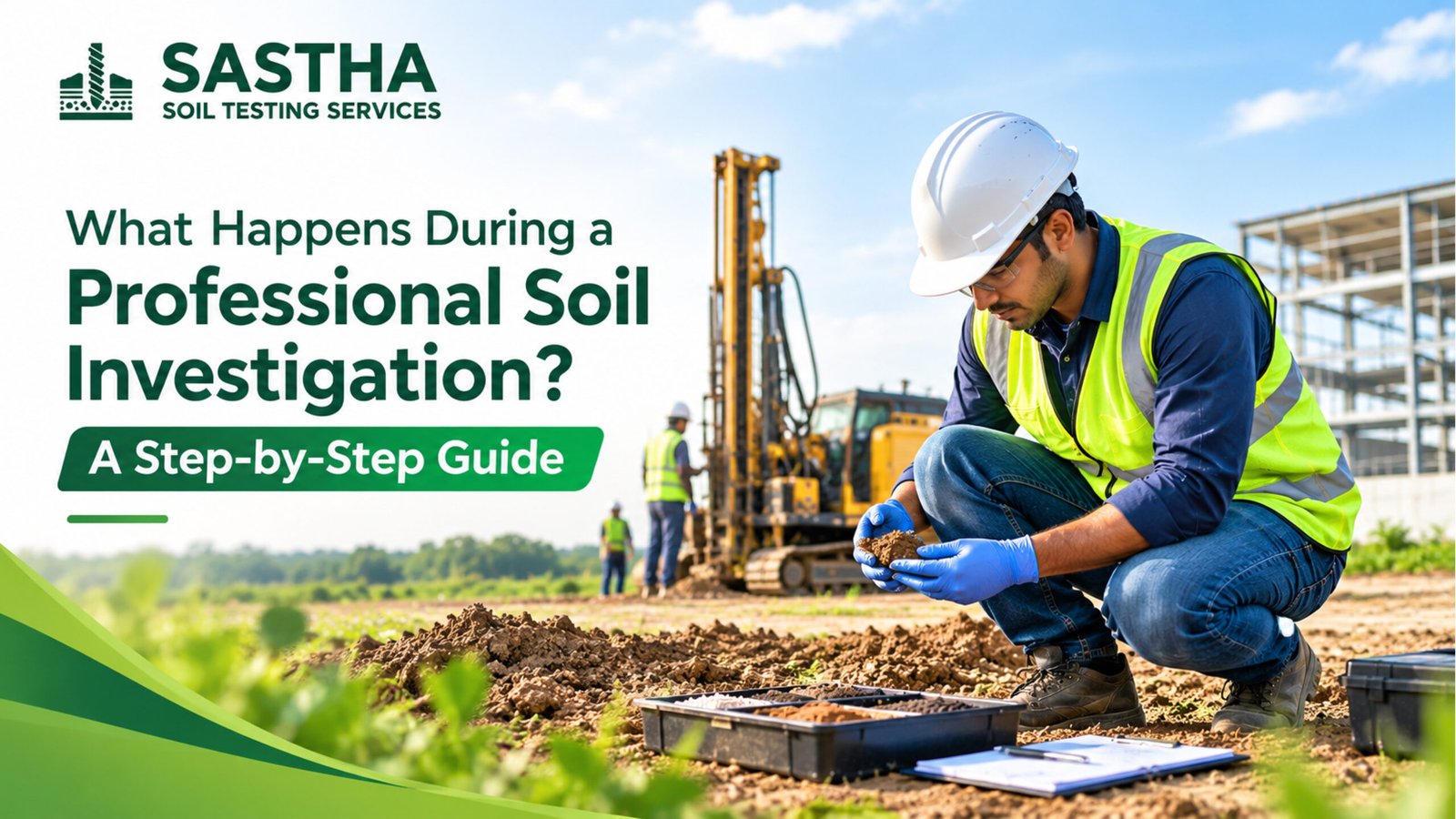
Step 4: Borehole Investigation and Soil Sampling
Depending on the project, boreholes may be created to investigate subsurface soil layers.
Samples are collected from relevant depths for further examination and laboratory testing.
The samples need to be properly identified, handled, and documented to maintain the connection between the laboratory results and the actual site conditions.
Step 5: Field Testing
Field testing may be performed during the investigation to obtain information directly from the ground.
Depending on project requirements, field investigation may include appropriate tests for evaluating soil and subsurface conditions.
Examples can include:
- Standard Penetration Testing (SPT)
- Field density testing
- Plate load testing
- Other site-specific geotechnical tests
The choice of test depends on the project and the engineering information required.
Step 6: Laboratory Testing
Collected soil samples are transported to the laboratory for detailed testing.
Depending on the investigation requirements, laboratory testing may include:
Physical Tests
- Moisture content
- Specific gravity
- Grain-size analysis
- Density
- Atterberg limits
Engineering Tests
- Compaction
- Shear strength
- Consolidation
- Permeability
- CBR and other relevant tests
Chemical Tests
- pH
- Chlorides
- Sulphates
- Other relevant chemical parameters
Not every project requires every test. The laboratory testing program should be selected according to the site’s characteristics and project requirements.
Step 7: Analysis of Test Results
Once field and laboratory testing is completed, the collected data is reviewed and analyzed.
The results help establish a clearer understanding of:
- Soil profile
- Soil characteristics
- Strength-related properties
- Groundwater conditions
- Potential settlement characteristics
- Other relevant geotechnical conditions
Engineers can then use the investigation data as part of their design and construction decision-making process.
Step 8: Preparation of the Soil Investigation Report
The final stage is the preparation of the soil investigation report.
A professional report generally includes relevant information such as:
- Project details
- Site information
- Investigation methodology
- Borehole or sampling information
- Field test results
- Laboratory test results
- Soil profile
- Relevant observations
- Technical findings
- Engineering parameters, where applicable
The report provides a documented record of the investigation and its findings.
Why Is Professional Soil Investigation Important?
1. Supports Foundation Planning
Understanding subsurface conditions helps engineers evaluate foundation requirements based on actual site data.
2. Helps Identify Ground Conditions
Different soil layers can have different engineering properties. Investigation helps identify these variations.
3. Helps Assess Settlement-Related Risks
Certain soil conditions may be more susceptible to settlement. Appropriate investigation provides data that engineers can consider during design.
4. Supports Construction Planning
Soil information can help project teams make better-informed decisions during planning and execution.
5. Helps Reduce Uncertainty
Construction without adequate knowledge of ground conditions can introduce unnecessary uncertainty. Professional investigation provides site-specific technical information.
Soil Investigation for Different Projects
Residential Buildings
Soil investigation can provide information required for foundation planning for houses and residential developments.
Commercial Buildings
Larger commercial structures may require more detailed investigation depending on structural loads and foundation requirements.
Warehouses
Warehouse projects can involve large floor areas and substantial structural and storage loads, making an understanding of ground conditions important.
Industrial Projects
Industrial facilities may include heavy equipment, machinery foundations, and large structures requiring appropriate geotechnical investigation.
Roads and Highways
Road projects require investigation of soil and subgrade conditions to support pavement and earthwork planning.
Bridges
Bridge foundations can transfer substantial loads to the ground, making detailed subsurface investigation particularly important.
How to Choose a Professional Soil Investigation Company
When selecting a soil testing or geotechnical investigation company, consider:
Accreditation and Quality Systems
Check whether the laboratory has relevant accreditation for the testing services required.
Technical Experience
Look for experience with projects similar to yours.
Testing Capabilities
Ensure the company has suitable field and laboratory testing facilities.
Reporting
Check whether the company provides clear and comprehensive technical reports.
Project Coverage
For projects across Tamil Nadu, verify whether field investigation services are available at your project location.
Professional Soil Investigation in Madurai
For construction projects in Madurai, understanding local ground conditions is an important part of responsible project planning.
A professional soil investigation in Madurai can provide site-specific information that supports engineers and construction professionals during foundation and structural planning.
Sastha Soil Testing provides soil testing, geotechnical investigation, construction material testing, concrete testing, pile testing, water testing, earth resistivity testing, and related services for construction and infrastructure requirements.
Conclusion
A professional soil investigation is a structured process that begins with understanding the project and site and continues through field investigation, sampling, laboratory testing, analysis, and reporting.
The information obtained through this process can help engineers better understand the ground conditions and make informed decisions during construction planning.
Whether you are developing a residential building, warehouse, commercial property, industrial facility, road, bridge, or other infrastructure project, professional soil investigation can provide valuable site-specific information before construction begins.